Eating with Chopsticks

A Chronicle of my journey through China
CET-Harbin Chinese Language Program
Richard U. Light Fellowship at Yale University

Pages

Chinese Style Chicken Tempura


Ma Laoshi has taught us another recipe in our Chinese cooking class.

Ingredients:
1 cup potato starch
1/2 cup flour
2 egg whites
cold water (you can even use use water with crushed ice)
2 chicken breasts
oil

Slice chicken breasts into slivers. You'll want to cut along the top of the chicken, shaving off slice by slice.

Then beat your egg whites until they are foamy white. Add in the potato starch, flour, and approximate 1/2-1 cup water. The mixture should be about as thick as cake batter, adjust starch, flour and water according to get to this thickness. Coat the chicken slices in the batter. You can let the chicken sit in the batter as you heat up oil in a wok or deep-sided frying pan. Heat up about 2-3 inches high worth of oil. When the oil starts crackling and popping, it is hot enough for you to carefully (using cooking chopsticks ideally) drop in coated chicken slices piece by piece. You want to be extremely careful during this step as you could get burned by stray cooking oil. Also use a spatula to scrape the chicken batter and pieces off the side of the wok so it doesn't stick. When the pieces fry to a LIGHT tan color, scoop them out and let them cool to a warm temperature--not burning hot anymore. Pour more oil into the cooking pan if it is no longer at 2-3 inches in height. Heat it up to a high heat until it begins to crackle and pop again. Carefully put the chicken pieces back into the oil to fry again until golden brown. Scoop them out and drain on paper towels or in a metal strainer. Serve. The absolute key to this recipe is to double fry, otherwise you won't get any of the crispiness you need, and the chicken might not even be fully cooked.

Ma Laoshi served our chicken tempura with a mixture of black pepper and salt on the side to dip it in. You can even sprinkle this mixture on top of the chicken if you think dipping is too much trouble, but sprinkle sparingly because it can easily become too salty. Also, I recommend serving this on a bed of green and red peppers or lettuce to add a sprinkle of color. If you really want to put in the extra work for a really tasty result, stir-fry the chicken with green and red pepper pieces, long dried pepper, and some chili oil for a spicy, tangy chicken dish. This recipe is a really good base for any coated chicken stir-fry, and you can even do this with other meats.

Best of luck to your eating with chopsticks adventures!

Mapo Tofu, Mild Northeast Chinese Version


Also known as "mala" tofu, this Sichuan dish has gained popularity all over China in its different variations. I learned a very mild 东北麻辣豆腐. I just wanted to post a quick recipe I learned from Ma Laoshi's northeast cuisine cooking class before I forget the ingredients. I have tried my best to find translations for all the Chinese names. Also, Ma Laoshi rarely gives us an accurate measurement of his ingredients, so I have guestimated based on what I saw. It could be wrong, but adjust according to your taste.

Ingredients:
1/4 cup Sichuan peppercorn (be careful, this stuff has the ability to make your tongue go numb)
1/4 cup star anise
1/2 package fermented black beans
Handful of dried heaven-facing pepper (指天辣椒), dried long and thin whole peppers you'll often find in Chinese cooking
Chili oil (I think the teacher actually used chili paste)
Chicken stock (powder, the Chinese brand with the orange/yellow can and a green cap)
Salt
Soysauce
Oil
2 large (5x3x3 inch) blocks of firm tofu, cut into small cubes (about 5 normal sized blocks should work)

In a wok or large-sized pan, heat up about 1 cup of oil. When the oil starts dancing, toss in the Sichuan peppercorn (I have been trying to find some kind of a replacement for Sichuan peppercorn, and the closest thing I can think of is dried fennel. However, try your best to find Sichuan peppercorn). Let the peppercorn fry in the oil for about 4-5 minutes before scooping out only the peppercorn and tossing it away. The oil should be nice and flavored with the "嘛" flavors of the peppercorn now. Next fry the star anise in the oil for about 2-3 minutes, but do not scoop it out.

Add in the tofu cubes with about 1.5 cups of water. Add in the chili peppers and chili oil/paste as well as the fermented black beans. Be careful when stirring tofu as it breaks easily. Always use the rounded back side of a spatula or a spoon to "push" the tofu around gently. Let the water boil in the mixture and allow the tofu to absorb the flavors. Gently stir to make sure the tofu doesn't burn at the bottom of the pan. At this time, you should test a small piece of tofu to see if it is cooked, also test out the flavors to see if it is spicy enough to your liking. Lower the heat to simmer and toss in 2 tablespoons or so of chicken stock and some salt. Also pour some soy sauce over the entire dish and "toss" everything. You might not be as amazing as my 82-year-old cooking teacher to flip a wok, but you can always give it a try if you don't mind sacrificing some tofu. Let it simmer for about 2-3 minutes as you prepare plates.

Since I love to cook, I have a few other suggestions to add more flavors to the dish. Try also tossing in the "head" of scallions (the light green part) in the oil when you first start, and then throwing in some chopped scallions into the dish. I also like some grated ginger. Also, you can add more things other than just tofu into the dish. Also try some green peas, thinly sliced pork, Wood Ear (木耳), thinly sliced carrots, green/red peppers, and anything else you can think of as long as it is suitable to cook in a short amount of time (don't want to overcook the tofu).

Ever ride a tandem bike?


I can safely cross that off my do-to list as my roommate and I rode through (太阳岛) Sun Island Park on a tandem bike creating the most picturesque scene of roommate bonding. CET took us to Sun Island on Saturday, and by Sun Island, they really mean SUN--it was about 100 degrees outside. We sipped on frozen bottles of water as we explored the park and rode on a water ride. The best part about the trip: it was my second time there in less than 12 hours. One of the guys in our program was invited to a huge beach party the night before and convinced about 15 of us to go with him. As we told the taxi driver Sun Island, he dropped us off in the middle of the park. We proceeded to wander around for over two hours trying to find this giant beach party. As we declined invitations from what seemed like Chinese fraternities, we walked in a huge circle around the island. When we finally found the party, it was so late that we left within half an hour. What a fail.

The next day after returning from biking in Sun Island and shopping in Zhongyang Da Jie, we decided to visit a Russian bar. And if you're looking for a Russian bar, why not go to a bar that is called the "Russian Bar." I thought it was a lovely name choice, as the guys grabbed beers, and we watched the Korea-Uruguay soccer match. A very boisterous Korean exchange student also joined us as he cheered for the ultimately unsuccessful Korea.

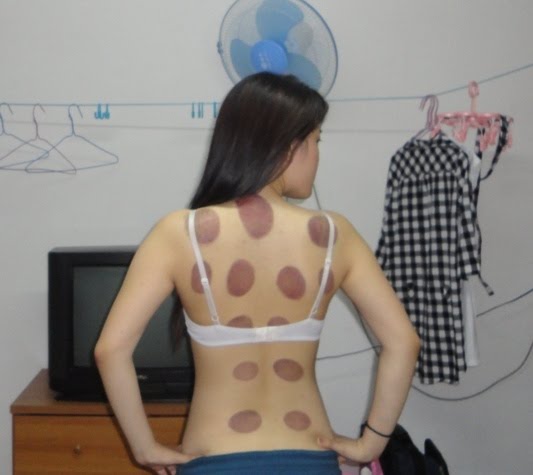
Another highlight of my week include fire cupping--a Chinese traditional massage/medicinal technique that basically involves setting a glass cup on fire, then putting it on your back. The hot air inside the cup creates a vacuum that suctions to your skin. The end result is a very dark and painful bruise on your back. According to Chinese traditional explanations, the dark coloration is from the violent expulsion of excess qi (air) from your body. Your body has a balance of hot and cold air, and when your body has too much of one or the other, you will feel very tired, restless, agitated, or even sick. Fire cupping will expel the imbalance in your body (排毒). I think an adequate western explanation for why people might like fire cupping is that it will stretch and move deep muscles that normally don't get stretched. Although the bruises may hurt, but a few days after fire cupping, you will feel like your back muscles are more relaxed (although this could also be the result of the 2 hour massage I got before the fire cupping).

See you next week!

Wuxi, Suzhou, Hangzhou, Shanghai Expo, Fuzhou, Harbin


Okay. It's been about two weeks since I last posted. Sorry about the lateness, but my internet was spotty in Fuzhou. To make up for it, I'll try to post an extra long post today before I start my Chinese homework.

To give you a quick rundown of the rest of my China tour first. I bought pearls in Wuxi and ate their famous marinated steamed pork. I bought a silk blanket from the silk capital of the world in Suzhou--a place that is also known for its beautiful women because all of the women stayed indoors making silk rather than going outside and farming (where they would get tan). Suzhou also offers great freshwater fish from the Great Tai Lake. Hangzhou offers its famous Dragon Well Green Tea--the best quality is always from the spring harvest, and we bought some of it. A woman who majored in Tea in college also provided a demonstration of the antioxidant effects of green tea. If you pour iodine onto rice, it will obviously turn the rice black, and you cannot rinse out the color with water. However, with a splash of green tea, the rice removed all traces of the iodine from the rice. It was amazing and convinced me even more of how awesome tea is. I also believe I went on three consecutive boat rides during this time visiting the beautiful lakes and canals of the three cities.

Our last major stop was in Shanghai for the Shanghai Expo 2010. For those unfamiliar with what a World Expo is, you may have heard of the St. Louis Expo around the turn of the 20th century when the US literally transplanted a Philippine village in the middle of St. Louis for people to gawk at. Basically the World Expo is a giant museum-fair where countries will sponsor a pavilion--many will build a building and house cultural marvels from their country (or in the US's case, a business fair with Microsoft, Johnson & Johnson, and other companies). Lines to get into some pavilions are literally hours. For Japan and Saudi Arabia, the estimated wait time is over 4 hours. For China's second floor exposition, it is well over 6 or 7 hours. But people will literally bring stools and sit in line just to experience these pavilions. Personally, I found the Expo way too crowded at over 400,000 visitors a DAY!!!

Next stop was my family's hometown in Fuzhou. Because it is monsoon season currently in Southeast China, I didn't do much but play 5 hours of mahjong everyday. I would win over 200 RMB on some days (my highest winning was 289 RMB), but on other days I would lose almost 200 (192 was my biggest loss). I think all in all, I came out of the mahjong marathon winning around 20 RMB (less than 4 US dollars).

I returned to Beijing to meet up with my Harbin program where we ate at a pretty fun pizza restaurant. It offered pizza of all different varieties from a 老北京 (Old Beijing--it was literally peking duck on pizza) to Meat Lovers. I also met some cool graduate students from NYU and their guide from the Chinese Foreign Affairs University. We took a night train to Harbin. The interesting thing was that it was a sleeper train that went through the night. We had four bunk-beds to a small cabin, and it was actually pretty comfortable with private TV's and reading lights.

Harbin is currently some of the strangest weather I have ever experienced. On some days, it is over 90 degrees and on other days it is down to 50 with thunderstorms. Mind you, I have only been here for 4 days, and everyone from Harbin I have spoken with have said similar things.

My roommate (同屋) is 王思霖, and she is one of the nicest girls ever. I had a minor cut on my foot, and she took m to buy band-aids. The store only sold non-waterproof ones, which I didn't care and bought some. Then a few hours later, I was preparing to go out and explore town with friends, and she came up to me with waterproof band-aids saying that it was going to rain. She also handed me an umbrella, which I was really grateful for because it started pouring about halfway through our exploring. I also come back to the dorm to find sliced watermelons, bubble tea, yogurt, and other goodies waiting for me on my desk from her. However, I don't know how to politely tell her that I really don't need all this stuff, and I've just been eating it all when it shows up.

I'll post more next week as classes continue. Today is only the first day, so I don't have much to say about classwork yet.

Tianjin & Beijing


These have been a super busy few days for me. In New York, I spent the day with friends going to lunch at Cafe Zaiya and dinner at Yakinuki (a Korean/Japanese barbeque) as well as visiting Central Park, MOMA, and a Karaoke joint.I flew from New York to Beijing--about a 13 hour flight. The cool thing was that I sat next to Chinese-language students from Bard College. They were studying in a summer program in Qinghai. Then I looked around my flight, and I realized many of the students were young Americans. I guess Chinese language study just keeps getting more and more popular. I got to Beijing and basically passed out in my hotel room for the night.

The next morning, we took a bullet train to Tianjin. The drive between Tianjin and Beijing takes about 2 hours. The train got us there in less than 30 minutes. It was a surprisingly comfortable ride for a train going over 320 km (approx 200 miles) an hour. We spent the afternoon in Tianjin visiting various important houses. During the early republic, warlords often set up their home or vacation home in Tianjin, so the area around Tianjin has beautiful architecture. We also visited Puyi's house in Tianjin (after he abdicated emperor-ship to the Republic of China/KMT). This house is also featured in the film, The Last Emperor. The other major thing about Tianjin was their food culture (丰富的食物文化). We actually visited this shopping mall that sold only food specialties. We tried these fried twisty dough things that are Tianjin's specialty (特产). In addition, we also tried cold noodles, sweetened plum drink, sweet sesame soup, fried red bean paste-filled mochi, and this green-bean flavored pancake with egg and sauces on top. I personally was not the biggest fan of Tianjin style food because I'm used to southern Chinese food, but it was an interesting experience.

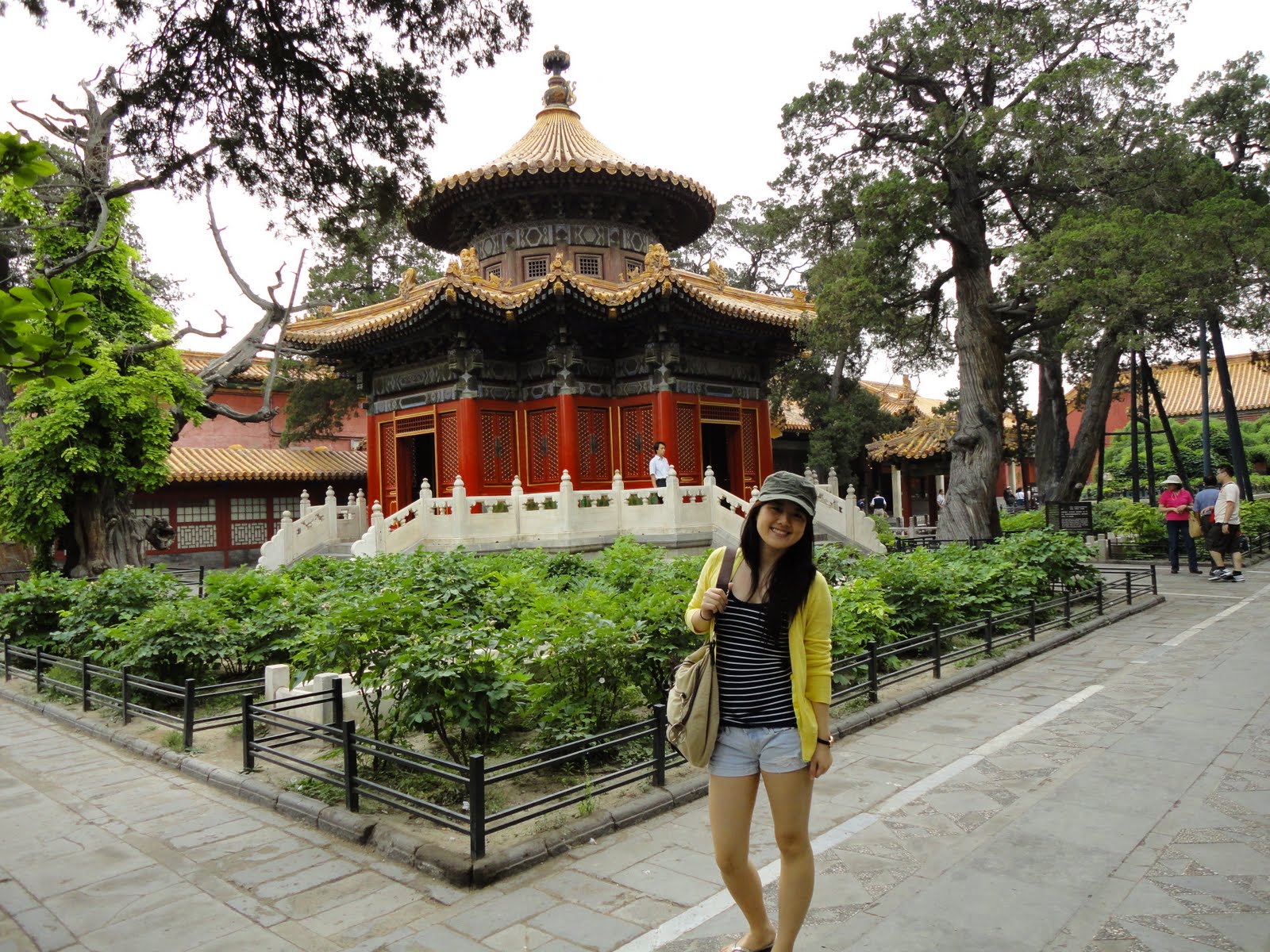
In Beijing, we visited the Forbidden Palace, Summer Palace, Tiananmen Square, Temple of Heaven, Bird's Nest, Great Wall, and others. They were super touristy places, so I don't have much to say about it. In the evening, we went to a pretty cool acrobat show with spinning plates, people contorting in strange directions, and Monkey King's fighting each other. We also tried the world-famous Peking Duck of course along with other Beijing specialties such as their rice wine. (I say rice wine but it had a 56% alcohol content!!)

Tomorrow we fly to Shanghai then drive to Suzhou.

First Entry: Light Fellowship Reporting

I will be traveling for NYC tomorrow. Meeting up with friends for a day in the city Saturday before leaving for China on Monday. To give you a quick summary, I am doing an east coast tour of China before my program begins. I am traveling through Beijing, Tianjing, Suzhou, Hanzhou, a few other random cities, and then to Shanghai for the Shanghai 2010 Expo. After spending 3 days at the Expo, I am traveling to my 老家 (hometown of my family) in Fuzhou, Fujian for a week. Then I will return to Beijing to meet up with the CET-Harbin group on June 16th to begin my language program. It'll be a busy few weeks, but I'll try to keep you updated as much as possible.

For anyone that might be reading this blog because they are interested in CET-Harbin or traveling to China on Light or traveling to China in general. I have been packing, and here's some helpful tips on what to pack for a trip through China. I was just in China over Spring Break too.

-Do NOT overpack on clothing. For most people, Chinese clothing will fit you rather well. Most stores in China sell pants at a long length, and you get it custom-tailored to fit your height. Clothes are also incredibly cheap and come in many styles. Personally, I usually bring around 5-6 outfits to China, and buy everything else there. Because I am going on a tour this time, I am packing a bit more.
-Pack personal toiletries--especially if you use certain brands. China does sell most US brands for toiletries such as Head & Shoulders, Olay, Vaseline, Pantene ProV, etc. However, you will notice that companies often change the formula when they sell the same product in a different country. Olay in China usually sells skin-whitening care. Pack your own toiletries if you are picky about them.
-Hand Sanitizer. If you are into street food, which I love, carry hand sanitizer around. I haven't seen it sold in those nifty travel size bottles yet in Chinese grocery stores, so it's helpful to bring your own. Also, many people in China can adulterate or dilute products to sell. I remember a street vendor selling Vaseline once, but the petroleum jelly was milky and creamy.
-Camera and laptop. Chinese electronics are super fancy and high-tech most of the time. But if your camera and laptop have international AC adapters, bring them. I've noticed Chinese cameras and laptops can't compete with the American brands--even if many of the American ones are made in China!
-Athletic shoes. If you are a runner, bring your own running shoes. Chinese shoes, like their clothing, come in many different styles. I highly recommend buying Chinese shoes for their variety (stores are limited in sizes they carry though). However, the quality of many shoes I have bought aren't the best. Bows and rhinestones will fall off, heels need to be secured sometimes by a shoe repair-man, etc. But they cost anywhere from $3-30 a pair. It's super cheap. But once again, for athletes, bring your own. Athletic shoes in China rarely have the insoles needed for a runner.
-Gifts for your hosts and friends in China. Always remember to be courteous! It's getting harder these days to buy gifts because anything you can get in the US, they can usually get in China. But my relatives really enjoy name-brand perfumes and colognes (which does get expensive). I also have a habit of giving away Yale gear to people.